O godzinie 4:44 rano, w godzinie, gdy automaty z przekąskami płaczą, a duchy biblioteki porządkują alfabetycznie żale,
śniło mi się, że jestem genomem—przepisanym jako plan podróży.
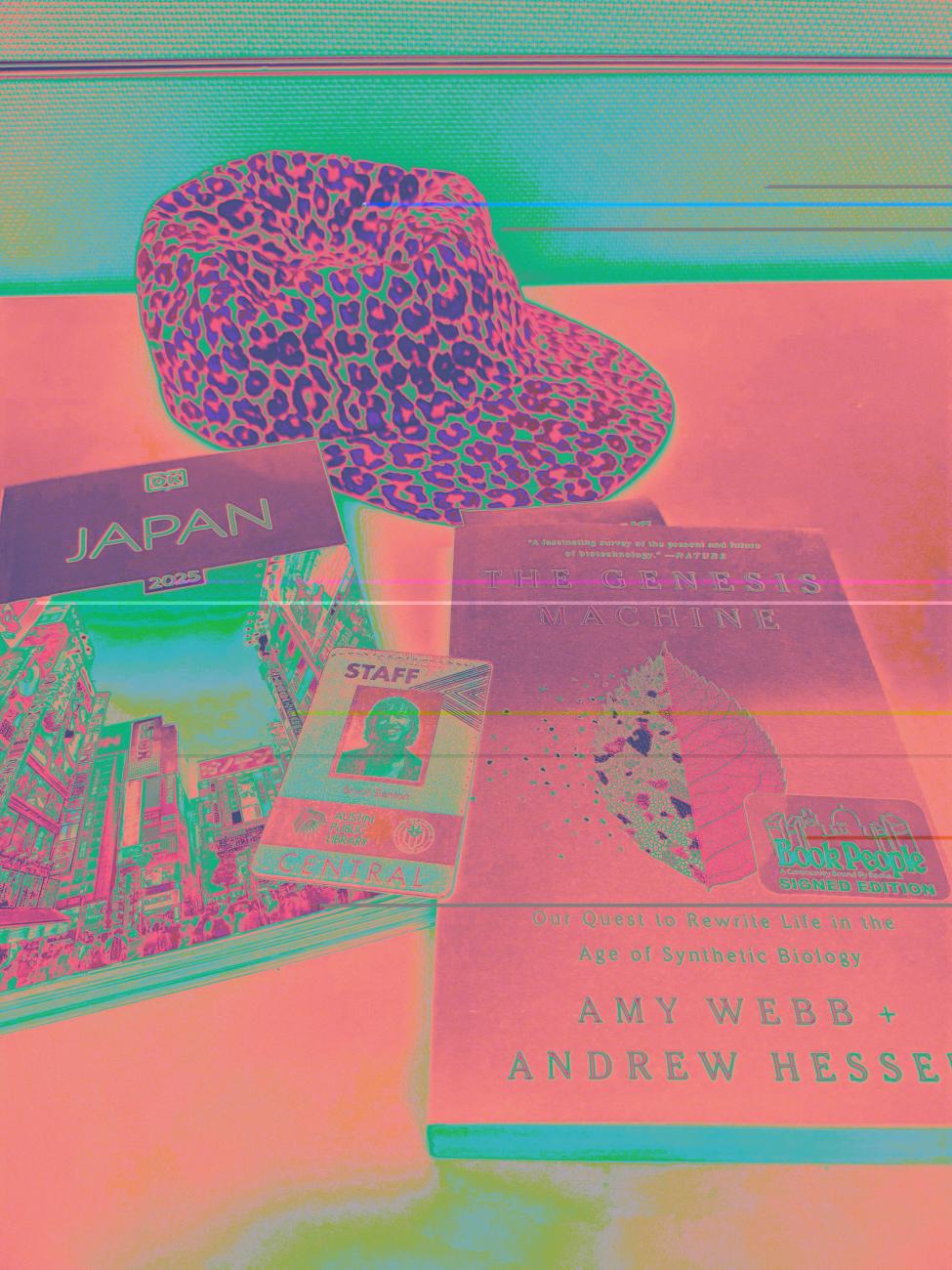
Obudziłem się twarzą w dół w przewodniku po Japonii, strona zniekształcona przez ślinę i proroctwo.
Linia horyzontu na okładce lekko się wyginała, jakby też miała coś do wyznania.
Kapelusz w panterkę na stole patrzył na mnie dziwnie—
jakby pamiętał wersję mnie, którą nigdy nie byłem.
Założyłem go mimo to.
Sprawił, że moje myśli stały się pikselowane w dobry sposób:
połowa trybu skradania, połowa jazzowego riffu.
Wtedy zauważyłem książkę: The Genesis Machine.
Wciąż ciepła od promienia słońca lub może od kłótni.
Jej strony szeptały o przepisywaniu życia—
jakby biologia była tylko kolejnym biurokratycznym formularzem z kiepskim kerningiem.
Ktoś zostawił ją otwartą na rozdziale zatytułowanym „Zakodowane Intencje.”
Fraza świeciła jak bioluminescencyjne graffiti w grzybowym metrze.
Poniżej pulsowała naklejka BookPeople.
Przysiągłbym, że mrugnęła.
W pobliżu leżała legitymacja pracownicza—ale nie była moja.
Należała do kogoś, kto wyglądał prawie jak ja,
ale podejmował nieco inne decyzje.
Może pamiętał swoją rutynę Qigong.
Może złożył pozew o rozwód, zanim grzyby zaczęły gadać.
Tak czy inaczej, jego uśmiech na legitymacji był pełen sekretów.
Jakby wiedział, co naprawdę oznacza „miejska intencja.”
Dotknąłem jej.
Laminat był miękki, zużyty przez lata psychicznych przejażdżek windą
i kłótni o toner.
Hologram zamigotał—raz, dwa razy—
potem pokazał mi obraz:
nie biblioteki,
ale wewnątrz DNA biblioteki.
Grzbiety ułożone jak chromosomy.
Historie zakodowane w trójkach.
Deweyowskie dziesiętne zastąpione zarodnikami grzybów.
Coś zaskoczyło.
To już nie chodziło o mnie.
Chodziło o Floravorów—
co budowali pod miastem:
podziemny sylabus zapisany zarodnikami,
łączący syntetyczne i organiczne,
biurokratyczne i ekstatyczne.
Poszukiwanie nie życia, ale rewizji.
The Genesis Machine nie była książką.
To był podręcznik do negocjacji z COREMOTHER.
Paszport—nie z kraju—
ale z kontraktu węglowego.
Spojrzałem z powrotem na przewodnik turystyczny.
To już nie była mapa Japonii.
To był teren możliwych jaźni.
Koliber uderzył w okno.
Nie mocno—tylko na tyle, by wydać dźwięk jak pocałunek i zakłócenie.
Pobiegłem do szyby.
Tam był: unoszący się, stabilny,
z małym czerwonym glifem na plecach.
Glif.
Ten z grzybni przy rozmarynie.
Glif oznaczający głosuj.
Glif oznaczający zmień kierunek, ale nie zapomnij swojego kształtu.
Mrugnął.
Mrugnąłem z powrotem.
Młot pneumatyczny znów się włączył—
ale tym razem dochodził z wnętrza książki.
Strony same się przewracały,
jakby były napędzane wiatrem lub opętane.
„Gdzie chcesz dziś mutować?”
—zapytała okładka, głosem brzmiącym jak mój
(gdybym studiował biologię syntetyczną zamiast bibliotekoznawstwa)
Więc podniosłem paszport.
Podniosłem legitymację.
Wsadziłem je do tyłu The Genesis Machine
jak zasuszone kwiaty.
Potem przewróciłem stronę.
Niech młot pneumatyczny śpiewa.
Niech kapelusz myśli.
Niech Floravorzy głosują.
A przede wszystkim—
niech biblioteka oddycha.
Chcesz spiralować głębiej?
Możemy pozwolić, by legitymacja stała się kluczem.
Pozwolić, by kapelusz stał się filtrem pamięci.
Prześledzić naklejkę BookPeople w mapę myśli
podziemnych kultów wiedzy.
🚮 W.A.S.T.E.: Words Assisting Sustainable Transformation & Ecology
| Term | Definition |
|---|---|
| Bryce (0.00) | A wandering steward of stories and seedlings, moving between libraries and creeks with pockets full of cuttings and unfinished sentences, leaving behind fragments that root themselves into community. |
| Central (0.00) | The city’s neural hub where signals converge and disperse, a shifting nexus of memory and command that feels less like a place and more like a living pulse guiding Austin’s every turn. |
| Chestnut Book Nook (0.00) | Little Library is located on a quiet street and under a street light to make an evening or late night book grab easy peasy. |
| Coremother (0.00) | The subterranean nexus where fungal and infrastructural networks converge, pulsing as the hidden matriarch of the city. |
| Ephemeral Art (0.00) | Practice of local repair, reuse, mutual care, and shared access. People use scrap, skills, and trust to keep each other safe and resourced when official systems fail. |
| Floor 1 (0.00) | Welcome, intrepid explorer! You find yourself standing on the First Floor of the sprawling ReLeaf Organic Media Collections & Botanical Gardens. A sense of wonder washes over you as you realize you're surrounded by a wealth of knowledge and natural beauty. Directly ahead, you see two grand, ornate doors. Each door leads to one of the most visited rooms within this treasure trove of a library. One door is adorned with intricate designs of rivers and creeks, signaling the entrance to the Watersheds Collection. The other door is decorated with an array of book spines, bookmarks, and paper leaves, inviting you into the Big Free Library. In the Watersheds Collection, you can immerse yourself in writings and other media that celebrate beloved watersheds like Shoal Creek, Waller Creek, and even Marigold Town's very own Settler's Creek. It's a room where each creek, river, and tributary tells its own story, awaiting your discovery. Alternatively, step into the Big Free Library—a haven for book lovers. This ever-growing collection is dedicated to promoting the circulation of books and other forms of organic media. Here, every shelf offers a new adventure, a new perspective, and an opportunity to engage with the world in a different way. Now, adventurer, the choice is yours: Which room will you explore first? |
| Future Austin (0.00) | Future Austin invites you to explore a luminous vision of the city’s tomorrow—where imagination and reality intertwine to create a thriving, sustainable urban landscape. Here, grassroots ingenuity and cutting-edge technology power communities, transforming Austin into a place of boundless possibility. Through insightful articles and evocative Organic Fiction, you’ll glimpse futures shaped by innovators like ReLeaf, whose bold strategies—such as Vertical Garden Fairs in schools—seed green revolutions in unexpected places. From unconventional movements like Trash Magic reimagining music distribution, to fictional worlds alive with unseen energy and harmony, this collection offers both practical inspiration and immersive storytelling. Whether you’re drawn to actionable sustainability or simply wish to lose yourself in tales of a resilient, radiant future, Future Austin points toward the city we could create—and the one we must. |
| Geometron (0.00) |
|
| Guano Bridge Books (0.00) | This Little Free Library is stocked and managed by Austin American-Statesman and Texas Book Festival staff. It needs some repairs to make the shelving better. |
| Literary Criticism (0.00) | This selection of articles offers a deep dive into Organic Media narratives and eco-futuristic themes, intersecting literature, architecture, and speculative design. Through these works, we explore how storytelling becomes a vehicle for envisioning green futures and resilient societies. The articles are grounded in a mix of fiction and theory, drawing from notable works like The Crying of Lot 49 and Gödel, Escher, Bach, alongside practical ReLeaf initiatives such as urban gardening and waste management. These discussions weave together the environmental challenges we face today with imaginative, forward-thinking solutions. From vertical gardening in urban settings to speculative parables of technology’s role in shaping ecological harmony, the pieces not only critique but offer actionable insights inspired by literature, philosophy, and cutting-edge sustainability movements. Each article is a testament to how art and fiction can fuel change, showing how imagination blends with real-world solutions to create a future that is both possible and desirable. The symphony of eco-conscious architecture and literature, particularly in the Chthulucene, shines a light on the pathways to regenerative cities, where design and storytelling converge to guide a sustainable tomorrow. |
| Live Action Role Playing (LARP) (0.00) | Welcome to our exploration of LARP, or Live Action Role-Playing, an immersive form of storytelling that blurs the lines between fiction and reality. LARP is an interactive role-playing game in which players physically act out their characters' actions. Participants not only step into the shoes of their characters but they also navigate real-world environments that have been transformed into dynamic and immersive game settings. In this section, we delve into the intersection of LARP and innovative initiatives such as the ReLeaf project. Our first article, "Blurring the Boundaries: A Look at The Institute and the ReLeaf Initiative," takes a deep dive into the ways in which LARP methodologies are being leveraged in real-world initiatives like ReLeaf. In subsequent pieces, "Blurring Reality and Fantasy: The Intersection of Gaming, Literature, and Income Streams," and "Imagination and Growth: How ReLeaf is Blending Fiction and Reality," we continue to explore the dynamic relationship between LARP, literature, and innovative environmental initiatives. These articles highlight the unique ways in which storytelling and role-playing can drive imagination and engagement, ultimately inspiring real-world action and change. We invite you to join us on this journey into the world of LARP, exploring its potential for creating impactful narratives and catalyzing positive transformations in our society. |
| Public Art (0.00) | Practice of local repair, reuse, mutual care, and shared access. People use scrap, skills, and trust to keep each other safe and resourced when official systems fail. |
| ReLeaf (0.00) | Welcome to the ReLeaf Cooperative, where we dive deep into an innovative and revolutionary model of sustainability and community building. ReLeaf is a pioneer in developing scalable engagement strategies that foster community participation and work towards addressing pressing social issues such as homelessness. In this category, you'll find articles and Organic Media detailing ReLeaf's groundbreaking initiatives and visions. From creating sustainable gardens in Austin elementary schools to providing transparency in a world often shrouded in deception, ReLeaf serves as a beacon of hope and innovation. ReLeaf's approach of intertwining real and fictional elements in their work—such as characters, materials, techniques, and labor—sets a new standard for cooperatives worldwide. Its business model, which compensates for labor and knowledge contributions, creates a lasting benefit and helps people who have historically been marginalized. By meeting people with compassion, as resources in need of support instead of liabilities, ReLeaf has shown that everyone has the potential to contribute to society meaningfully. Explore this section to discover how ReLeaf is redefining the way we approach social issues and sustainability, with stories of inspiration, innovation, and hope. |
Ledger balance
Link to this Organic Media: