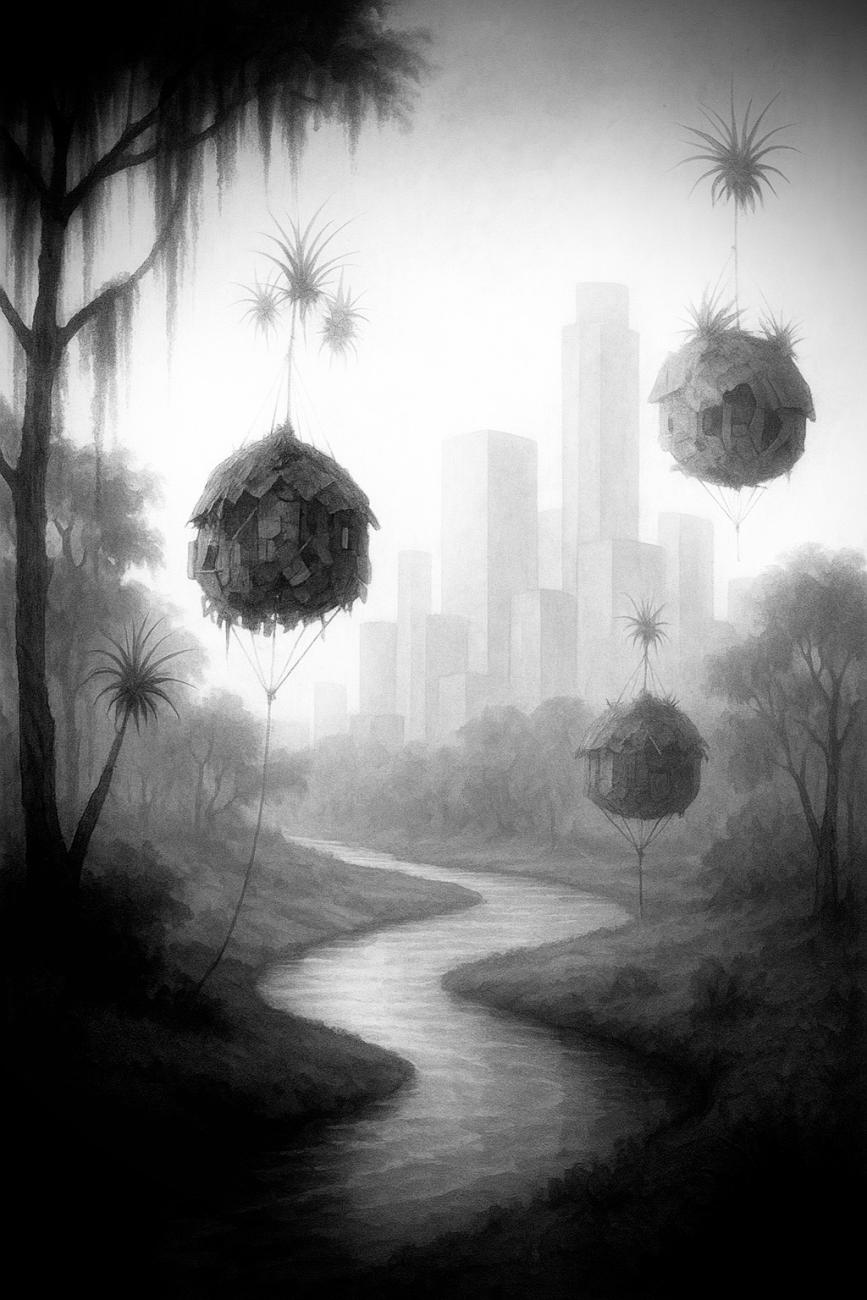
Bryce stepped lightly along the Shoal Creek Trail as dusk settled over near-future Austin. The creek beside him whispered over stones, a ribbon of water reflecting the last orange light of the sky. Above the gentle gurgle, the city’s new levitating homes floated like lanterns tethered against the coming night. One hovered overhead now – a small dome patched together from upcycled metal and bottle-green glass – its reflection wavering in the creek below. Bryce paused and watched the water distort that bright little home, stretching and recoiling it in patterns that reminded him of memory itself.
A warm breeze carried the scent of damp earth and the faint sweetness of blooming evening primrose. In the canopy of pecan and oak trees lining the creek, cicadas started their crescendo, underscoring the hush of the hour. Bryce slid his hand along the limestone edge of the trail, feeling the rough, ancient shells embedded in the rock. “You never step in the same creek twice,” he mused silently, recalling an old saying. Each moment the water was new, yet the creek bed remained—a paradox of change and continuity, just like a person’s self.
Up ahead, Shoal Creek wound into downtown, where glass high-rises caught the sunset. The skyline had transformed in recent years, sprouting rooftop gardens and gleaming solar panels – and, tethered near some rooftops, a few of those self-constructing levitating domiciles bobbed gently. They were the pride of Austin’s ambitious housing initiative, homes that built themselves from reclaimed waste and hovered safely above floodplains. The physical crisis of homelessness had been declared resolved; no one slept on the cold ground or under bridges anymore. Everywhere Bryce looked, these dwellings floated like benign clouds, anchored by steel cables to parks, plazas, and rooftops.
As he walked under one, he heard laughter. A little girl peeked over the railing of the floating porch, her face lit by a string of solar fairy lights wrapped around the dwelling’s frame. “Hi there!” she called to Bryce. Her mother appeared behind her, smiling apologetically at the stranger below. Bryce waved and grinned.
The sight of a family secure in their buoyant home gave him a pang of joy edged with longing. Safe, tangible homes for all — it had been a dream for so long. And yet… why did he still feel this ache?
Bryce continued on, the creek guiding him like a familiar memory. He remembered the Austin of a decade ago, when tents and makeshift camps dotted this creek’s banks. He remembered cold nights when he himself had huddled under the 12th Street bridge, just a few miles upstream, listening to the water and wishing for a miracle.
That miracle had come, at least in part. Now Bryce lived in a comfortable apartment—though he spent more time wandering these trails than inside four walls. He brushed a hand through his sandy hair and adjusted the strap of his shoulder bag, where a portable holo-projector – his storyteller’s toolkit – bumped against his hip.
At a bend in the creek, Bryce nearly tripped over a tangle of roots. He stumbled and caught himself on the trunk of a bald cypress that leaned over the water. The tree’s exposed roots, like gnarled fingers, knuckled into the stream. He took a breath, steadying himself.
A great blue heron standing in the shallows startled at his sudden movement and flew a few yards downstream, landing gracefully again among the reeds. Bryce watched its wide wings send ripples across the surface. He envied the bird’s poise. I’m as jumpy as ever, he thought.
The day was dimming further, twilight deepening to a velvety blue. Downtown’s lights blinked on in the distance, and the first stars pricked through the sky. Bryce’s destination was not a place, but a state of mind—a sense of clarity he hoped the walk would bring. Lately, in his work as an immersive storyteller, he’d been grappling with doubt.
The new media project he was developing sat heavy in his bag in the form of that holo-projector and countless lines of experimental code. It was a piece about recursion and memory, about revisiting one’s own story over and over until its darkest chapters lost their power. His aim was to help others find self-acceptance by literally rewriting the emotional script of their lives. A lofty goal, one not easily understood by everyone.
From across the creek, Bryce heard voices. Two men were conversing on a bench beneath a streetlamp that cast an amber cone of light. As he drew nearer, their words became clear.
“I’m telling you, man, it’s solved. Solved!” one man was saying emphatically. He wore the uniform of a city maintenance worker—navy blue with reflective stripes—likely on break. “Look around. Nobody sleeping rough out here no more. City did it. Floating houses for everyone who needed one. You remember what it was like? Tents everywhere, people suffering… Now, zero. We did it.”
The other man, older and wearing a threadbare jacket despite the warmth, shook his head. “Physically, sure,” he replied. “Roof over everyone’s head, okay. And it’s a beautiful thing, I agree. But have you talked to folks who moved into those pods?” He gestured upwards where one of the levitating homes hovered, tethered to a concrete footing near the trail. Its hull, a patchwork of reclaimed wood and salvaged plastic, glinted softly. “Some of ’em lived decades on the street or in trauma. They’re happy to be safe, but they ain’t exactly home on the inside. You can’t fix that with four walls, even if those walls float.”
The maintenance worker frowned. “What do you mean, not home on the inside?”
The older man searched for words. “It’s like… you ever been in a house but felt you didn’t belong there? Like you were still out in the cold, looking through the window? A lot of folks feel that way inside their own skin. Emotional homelessness. They finally got a house, but their heart…” He thumped his chest. “…their heart’s still wandering.”
Bryce had stopped, pretending to tie his shoe, eavesdropping from behind the cover of crepe myrtles.
The worker snorted. “Sounds like some psychology mumbo-jumbo. You saying all this—the city’s effort, the tax dollars—didn’t matter?”
“Of course it mattered,” the older man said, voice gentle. “It saved lives. But there’s more work. Different kind of work.”
“Ha! Tell that to the mayor. They’re already talking about our city as if it’s utopia now.” The maintenance man stood, stretching. “I get what you’re saying, Joe, but some folks are never satisfied. There’s always gonna be something to fix. At least now people ain’t dying on the streets. I’d call that good enough for one lifetime.” He patted his friend’s shoulder. “Anyway, break’s over. See you around.” With that, he trudged off, toolbox clanking at his side.
The older man—Joe—watched him go, then sighed and looked toward the creek. Bryce felt a kinship with that weary sigh. He stepped forward out of the shadows. “Evening,” he said softly.
Joe turned, a bit surprised but nodding in greeting. “Evening. Nice night for a stroll.”
“It is,” Bryce replied. He hesitated, then added, “I couldn’t help but overhear. What you said about hearts still wandering… that was beautifully put.”
Joe squinted at him through the dusk. He had kind eyes etched by years of sun and hardship. “Thanks. I was just speaking plain truth. Lived it myself.” He scooted over on the bench, offering Bryce a seat.
Bryce sat. The wood of the bench was warm, holding the last of the day’s heat. Across the creek, a firefly winked above the water. “You lived on the street too?” Bryce ventured.
Joe nodded. “Seven years. Me and my brother. This was maybe fifteen years back. I lost him to an overdose eventually. After that… I was lost too, even after I got into housing.” He gestured vaguely toward the nearest floating home overhead. “These came too late for him. For me, they sure help—I ain’t ungrateful—but sometimes I wake up and don’t know where I am, like I expect to be under a bridge again. Takes me a minute to feel… real.” He tapped his temple. “Up here. Memory’s a tricky thing.”
Bryce felt a pang of empathy. Normally reserved, he found himself opening up in return. “I… I was on the streets for a couple years in my twenties,” he admitted. “Down by this very creek. It was before the new homes program. A shelter finally helped me get on my feet, but…” He swallowed, the old shame and pain rising in his throat unbidden. “Even after I had a roof again, I carried the streets with me inside. I kept expecting everything to fall apart. It’s taken me years to feel even a little bit at home in my life.”
Joe looked at Bryce more closely. “I hear ya. You’ve turned out okay though, seems like.”
Bryce allowed a small smile. “More or less. I have a place, a job. I tell stories—well, create immersive story experiences. Trying to help folks the way stories helped me.”
A grin crept onto Joe’s weathered face. “Stories saved me too, in a way. Library downtown, it was like a church for me once I got sober. I’d go read for hours, get lost in other lives. That Central Library’s a beaut, isn’t it? Looks like a lantern over the creek.”
Bryce followed Joe’s gaze down the trail. From here they could see the Austin Central Library’s silhouette—a modern angular structure with broad windows—overlooking the creek just a couple blocks away. Its lights glowed gold, reflecting off the water where Shoal Creek met Lady Bird Lake. “It is,” he agreed. “In fact, I’m headed that way now. There’s a spot behind the library where the creek flows into the lake—I like to watch it join the larger water.”
Joe chuckled. “A man after my own heart. That’s a fine sight. Mind if I walk with you?”
“Not at all,” Bryce said, standing. His legs had stiffened a bit; he realized he must have walked farther than he thought, lost in thought earlier. Joe stood more slowly, one hand on the bench arm to steady himself. Together they continued along the path.
As they walked, tethered homes gently swayed above, their cables creaking softly. One home they passed had wind chimes hanging from its lowest porch step, and as it bobbed, the chimes tinkled a random melody. Bryce imagined the sound swirling with the night breeze, across the water and between the trees, perhaps all the way to the lake.
“So you make immersive stories, eh?” Joe asked after a few moments. “What does that mean exactly?”
Bryce searched for an explanation that made sense. “It’s like… combining virtual reality with personal memories. I create narratives people can step into. The story adapts to their responses, and can even incorporate their own memories if they’re willing to share. It’s a bit like guided dreaming.”
“Sounds fancy,” Joe remarked, though not dismissively. “What kind of stories?”
“Ones that can loop back on themselves. Recursion is a big part of it—repeating scenes with slight changes. The idea is to let someone revisit a painful memory but gradually alter the experience, so they can heal or see it differently.” Bryce glanced at Joe, hoping it didn’t sound too strange.
Joe rubbed his chin. “Like exposure therapy meets storytelling?”
Bryce smiled. “Exactly. But more collaborative. The person becomes a character in their own story and can reshape it. I’m working with a small community group to test it out—folks who’ve been through trauma or homelessness. It’s early, but I’ve seen some breakthroughs. People forgiving themselves… letting go of things. It’s powerful.”
They crossed a small footbridge arching over the creek. Below, the water was darker now, carrying the sky’s deep indigo. Joe peered over the railing at the current. “Lord knows, making peace with the past is hard. I still see my brother’s face at times…” He trailed off, then shook his head. “I think what you’re doing is good. Real good. Don’t let fellas like my friend back there tell you it’s pointless.”
Bryce exhaled, tension easing from his shoulders he didn’t realize he’d been holding. “It helps to hear that. Honestly, earlier today I was talking with a city liaison about funding for the project. He basically said, ‘Why bother? We already solved homelessness. Everyone has a home now.’ He couldn’t understand why some of us are still focusing on mental and emotional health. I left that meeting feeling like maybe I was crazy for pushing this.”
Joe snorted. “Typical bureaucrat thinking everything’s a box to check off. They checked the ‘homes’ box and thought the work was done.”
“Yeah,” Bryce said, kicking a pebble off the bridge into the stream. They watched the ripples spread out, merging with the flow. “I know better. I lived it, and people like you did too. But it’s still hard, going against the narrative that everything is fine now.”
The two men walked on as the path curved behind the Central Library. Here the creek widened at its mouth, joining the expanse of Lady Bird Lake. A pedestrian bridge crossed the water, and they took it, stepping out over the gently lapping lake edge. The city hummed around them—distant music from Rainey Street, the whoosh of a quiet electric bus on the avenue, laughter from a rooftop bar—but over the water it all softened.
Bryce stopped at the middle of the bridge. Joe came to a stop too. On one side, they could see back up Shoal Creek, the way they had come—a darker ribbon under the scattered lights of the trail. On the other side, Lady Bird Lake stretched out, the moon’s reflection wavering on its surface amid skyscraper reflections.
“Every creek finds its way to a greater water,” Bryce said, leaning on the rail. “Sometimes I think of individual lives like that. We have all these little tributaries of memory, flowing through us. Eventually they merge into something bigger—maybe a collective consciousness or just the next generation’s memory. Renewal.”
Joe nodded thoughtfully. “Never thought of it that way. But water is life, they say. And memories are life too, in a sense.”
For a few minutes they stood in comfortable silence. A few bats flitted overhead, newly emerged from under the Congress Avenue Bridge downstream to hunt insects. The water below glimmered with city lights and the last colors of twilight.
Bryce broke the silence softly. “Do you feel at home now, Joe? In yourself, I mean.”
Joe rested his weathered hands on the rail. “More than I used to,” he answered after a moment. “Took time. And people who cared. I had a counselor, I had books, I had faith. And these days, I try to help others – like chatting with you – and that helps me feel I belong on this Earth a bit more.” He turned to look at Bryce. “How about you, son? You feeling at home yet?”
Bryce felt a slight tremor in his chest at the direct question. He gazed down at the meeting of creek and lake, as if the answer might be written in the converging ripples. “I’m getting there,” he said quietly. “Walking helps. Telling stories helps. Meeting people like you… it reminds me I’m not alone in feeling the way I do.”
“You surely ain’t alone,” Joe said. “Not as long as people are honest about what they feel. That’s half the battle, I reckon—admitting when you feel lost. So you can start finding your way.”
A gentle smile played on Bryce’s face. The words resonated, settling into him like stones sinking kindly to the creek bed, forming new ground. “Thank you.”
Far above, one of the tethered homes drifted into view, its rounded form silhouetted against the sky now awash with starlight. Its tether line glimmered faintly with embedded LEDs, a safety measure for low-flying aircraft. The home looked almost like a small moon, hovering between earth and heaven. Bryce imagined for a moment that it was his own heart, finally untethered from fear, floating freely but held by the slender line of connection—to others, to the world—that kept him from floating away.
Joe let out a soft “heh,” noticing Bryce’s upward gaze. “Quite a sight, these floating houses. Who would’ve thought?”
“They’re incredible,” Bryce agreed, eyes still on the drifting domicile. In one of its windows, a pot of ivy trailed tendrils of green, and a paper lantern swayed in the breeze. Someone had made it truly home. “They solved one part of the problem brilliantly.”
“And folks like you will help solve the other part,” Joe added.
Bryce took a deep breath of the night air, filled with the smell of water and the faint fragrance of flowering vines that climbed the bridge railings. He felt a calm determination kindling inside. “I hope so. No—I will. We will. It’s like the creek: the work flows on, even when it seems still.”
Joe patted his back. “That’s the spirit, son.”
From somewhere nearby, a voice called out: “Joe! Hey, Joe!” Bryce and Joe both turned to see a woman on the far end of the bridge, waving. “That your daughter?” Bryce asked.
Joe nodded with a grin. “Yep. Probably wondering where I wandered off to. She lives in one of those,” he pointed at the floating pod overhead, “and keeps an eye on her old man.”
They began walking to meet her. As they drew close, the young woman hopped up onto the bridge. She had Joe’s kind eyes and carried a reusable canvas bag of groceries. “I was getting worried, Dad,” she scolded lightly, then smiled at Bryce in polite surprise.
“Sorry, got to talking,” Joe said. “This here is Bryce. We were just enjoying the view.”
“Nice to meet you, Bryce,” she said. “I’m Helena.”
Bryce returned the smile. “Likewise.” He could see a family resemblance in the set of her shoulders—strong but gentle. Helena glanced between the two men, sensing a meaningful conversation had passed.
“Well, I’m glad Dad had good company. It’s a beautiful evening.” She shifted the grocery bag and nodded toward the far bank. “I’d invite you both for a cup of tea, but my place is a bit small for three,” she joked.
Bryce pictured Joe and his daughter in the cozy floating home, sharing tea while tethered a few feet above the earth. A simple scene that years ago would have been unimaginable. “Another time maybe,” he said kindly. “I should get going anyway.”
Joe shook Bryce’s hand. “Keep that story project going, you hear? You’re doing the Lord’s work, or whatever you wanna call it.”
A flush of gratitude warmed Bryce’s face. “I will. And… thank you, for sharing your walk and your story with me.”
They said their farewells, and Bryce watched as Joe took his daughter’s arm and they headed toward a well-lit path, presumably to where Helena’s levitating home was tethered nearby. Their figures soon disappeared behind a stand of cypress trees and a public art sculpture shaped like a giant open book, one of the new installations along the trail.
Now alone again, Bryce leaned on the railing for a final moment, looking over the water. He closed his eyes and let his other senses take over. He felt the wooden rail solid under his palms, the subtle vibration from the moving water below. He heard the soft chorus of night insects and the distant murmur of the city. He inhaled deeply – the smell of algae and wild grass mixed with the cooling concrete of downtown – a strangely comforting scent of a city at peace for the night.
In his mind’s eye, he saw Shoal Creek as it had been earlier in the day, sunlight playing on its surface. He saw it as it was now, dark but steadfast, flowing onward. And he imagined it in the future, after a rain, swelling with new water, brimming with life again. Renewal – that was the creek’s gift, constant renewal.
Bryce opened his eyes. In the darkness, he caught his faint reflection in the water below: just the suggestion of a face, ghostly and superimposed on the stars and city lights. Once, he might have felt estranged from that face, as if it weren’t quite his own. Tonight, though, he felt a tender recognition. He was looking at someone who had been lost and found, many times over – and would be again – yet who always, like the creek, found a way to keep flowing.
He smiled to himself, a quiet, genuine smile that only the night and the water witnessed. Then Bryce turned and began to make his way off the bridge and toward home. Not just the physical home waiting for him in the city, but the feeling growing steadily in his chest – a feeling of being at home in his own skin, as gentle and persistent as the current of Shoal Creek carrying him forward into tomorrow.
🚮 W.A.S.T.E.: Words Assisting Sustainable Transformation & Ecology
| Term | Definition |
|---|---|
| Bryce (0.00) | A wandering steward of stories and seedlings, moving between libraries and creeks with pockets full of cuttings and unfinished sentences, leaving behind fragments that root themselves into community. |
| Central (0.00) | The city’s neural hub where signals converge and disperse, a shifting nexus of memory and command that feels less like a place and more like a living pulse guiding Austin’s every turn. |
| Consciousness (0.00) | The shifting field of awareness where perception, memory, and meaning converge into the experience of being. |
| Creekback (0.00) | The soft push at your ankles when Shoal Creek sends ripples both upstream and downstream. People feel it as a quiet yes from the past. |
| Future Austin (0.00) | Future Austin invites you to explore a luminous vision of the city’s tomorrow—where imagination and reality intertwine to create a thriving, sustainable urban landscape. Here, grassroots ingenuity and cutting-edge technology power communities, transforming Austin into a place of boundless possibility. Through insightful articles and evocative Organic Fiction, you’ll glimpse futures shaped by innovators like ReLeaf, whose bold strategies—such as Vertical Garden Fairs in schools—seed green revolutions in unexpected places. From unconventional movements like Trash Magic reimagining music distribution, to fictional worlds alive with unseen energy and harmony, this collection offers both practical inspiration and immersive storytelling. Whether you’re drawn to actionable sustainability or simply wish to lose yourself in tales of a resilient, radiant future, Future Austin points toward the city we could create—and the one we must. |
| Geometron (0.00) |
|
| Guano Bridge Books (0.00) | This Little Free Library is stocked and managed by Austin American-Statesman and Texas Book Festival staff. It needs some repairs to make the shelving better. |
| Historic Homelessness (0.00) | In this next section, we invite you to envision a world where homelessness, a complex issue deeply entrenched in economic inequality, lack of affordable housing, and inadequate mental and physical health support, is no longer prevalent. We explore how ReLeaf, an innovative company in Austin, Texas, is actively working towards making this vision a reality. Through their creative and compassionate initiatives, they are not just tackling homelessness but also shaping a future where everyone has a place to call home. The articles that follow will explore ReLeaf's unique approach. They demonstrate how employment opportunities and community engagement, stemming from their ecological solutions of vertical gardens, are offering a pathway out of homelessness. But they do more than that. They offer a window into a future where a secure home is a universal reality. Imagine a world where the uncertainty of shelter is no longer a concern. How would that transform our cities, our communities, our interactions? What happens when every person has a place they can call their own? A place where they can grow, dream, and contribute to society. We begin to see that it's not just about the elimination of homelessness; it's about the creation of a society characterized by security, stability, and dignity for all. A society where everyone has a meaningful role and the opportunity to live a fulfilling life. Join us as we journey through this potential future, drawing inspiration from the steps taken by ReLeaf. As we move through this exploration, we encourage you to imagine the transformative power of a society that has effectively addressed and eradicated homelessness. |
| Lake Exhale (0.00) | The felt breath of Lady Bird Lake offering quiet forgiveness that loosens the day. |
| Library (0.00) |
|
| Mintstep (0.00) | The clean snap of scent released by the mint between the pavers along the creek. It signals steady footing and readiness to help. |
| Organic Media and Fiction (0.00) | The rapid pace of urbanization and its environmental impact has inspired various speculative genres in literature and media. Organic Media and Fiction, a recent addition, offers a refreshing counter-narrative to dystopian futures, focusing on optimistic, sustainable societies powered by renewable energies. ReLeaf, an Organic Media and Fiction-inspired platform, epitomizes this genre by blending reality with narratives that envision a world where humans coexist harmoniously with nature and technology. ReLeaf's ethos is rooted in the belief that a hopeful future of sustainable living is not just an ideal but a reality. It combines engaging storytelling, visual arts, and direct action to showcase the possibilities of an Organic Media and Fiction future. By merging immersive narratives with tangible solutions, ReLeaf serves as both a creative outlet and a catalyst for change. The narratives in ReLeaf are set in cities that integrate renewable energy and green technology into their architecture, infrastructure, and daily life. From urban gardens atop skyscrapers to solar-powered public transport, these stories offer a glimpse of future urban landscapes grounded in existing technologies and practices. They provide an encouraging perspective on how our cities could evolve by amplifying sustainable practices we are already exploring. ReLeaf's stories feature diverse, inclusive, and community-oriented societies, emphasizing social justice, community empowerment, and equitable resource distribution. These narratives reflect societal structures that could foster a balanced coexistence, highlighting the importance of these values in creating a sustainable future. Beyond storytelling, ReLeaf engages in direct action, promoting real-world initiatives that echo Organic Media and Fiction principles. By supporting community-led renewable energy projects and sustainable urban farming, ReLeaf bridges the gap between the Organic Media and Fiction vision and our present reality, making the dream of a sustainable future feel achievable. ReLeaf broadens the understanding of the Organic Media and Fiction genre by presenting a balanced blend of reality and narrative. It underscores that Organic Media and Fiction is not just a literary genre or aesthetic movement, but a lens through which we can view and shape our future. The Organic Media and Fiction vision put forth by ReLeaf invites us to imagine, innovate, and create a future where sustainability is the norm. By intertwining fiction with reality, it presents Organic Media and Fiction as a plausible future, offering a hopeful counterpoint to narratives of environmental doom. ReLeaf helps us believe in—and strive for—a future where humans live in harmony with nature and technology. |
| Phluger Pedestrian Bridge (0.00) | Practice of local repair, reuse, mutual care, and shared access. People use scrap, skills, and trust to keep each other safe and resourced when official systems fail. |
| Planterns (0.00) | Planterns are whimsical upcycled creations—paper lanterns transformed into one-of-a-kind planters. No two are ever the same: each Plantern carries its own identity, tied to a unique ID that connects it to specific digital media such as Organic Fiction narratives, recorded music, and other creative works. The soft glow and airy shape of its former life remain, now reimagined as a home for trailing vines, succulents, and blooms. Made from reclaimed materials, Planterns celebrate renewal—giving discarded objects a second chance and your plants a distinctive stage to grow. Part art piece, part living sculpture, a Plantern is both physical and digital—a tangible vessel for life linked to a story, a song, or a world you can step into. |
| Sara Stevenson (0.00) | I'm a middle school librarian, and I first saw a free little library up in Seattle this summer. l've seen them popping up around town and told my husband I would love him to make me one. Never did I imagine he would produce such a fine piece of woodwork and construction, a mini replica of our house. Now I can be a 24-hour librarian. |
| Shoal Creek (0.00) | Shoal Creek is changing. At the Seaholm Intake, the water and stone hold a new role for the city. Engineers and naturalists are close to confirming a time-bending effect in the current. Short pulses move both downstream and upstream. Standing near the intake leaves people rested and clear, as if a long afternoon just ended. This site becomes a public time commons. The cooled chambers host sensors and quiet rooms. The walkway links to Central across the water. The mycelium network listens, then routes what the creek gives: steadier attention, better recall, and a calm pace for work and care. What to expect: Check-in stones that log a short visit and return a focus interval Benches that sync with the flow and guide five-minute rest cycles A simple light on the rail that signals when the current flips A small desk for field notes and shared observations Open data on pulse times so neighbors can plan repairs, study, and gatherings Invitation Come without hurry. Sit by the intake. Let the water set your pace. Then carry that steadiness back into the city. |
| Silver ponysfoot (0.00) |
|
| Trust Current (0.00) | A mild tingling behind the eyes when people witness a verified act of generosity. Neurologists call it a mirror-empathy response; poets call it the return of faith. |
| Upcycling (0.00) |
|
| Waller Creek (0.00) | Waller Creek is a stream and an urban watershed in Austin, Texas, United States. Named after Edwin Waller, the first mayor of Austin, it has its headwaters near Highland Malland runs in a southerly direction, through the University of Texas at Austin and the eastern part of downtown Austin to its end at Lady Bird Lake. |
| Waste Integration (0.00) | In a world grappling with waste management crises, Waste Integration offers a novel solution. This philosophy looks beyond mere recycling or upcycling; instead, it weaves waste into the very fabric of our everyday lives in a meaningful and beautiful manner. Explore a wealth of creative methods to turn your home and community into sustainable ecosystems, where every item has a purpose, and nothing goes to waste. From transforming scrap metal into functional art, to building modular planters out of discarded plastic, Waste Integration is a testament to human creativity and resilience in the face of environmental challenges. With a combination of theoretical discussions, practical guides, and inspiring stories, our Waste Integration content shines a spotlight on this game-changing movement, demonstrating how each one of us can contribute to a more sustainable and circular economy. |
Ledger balance
Link to this Organic Media: