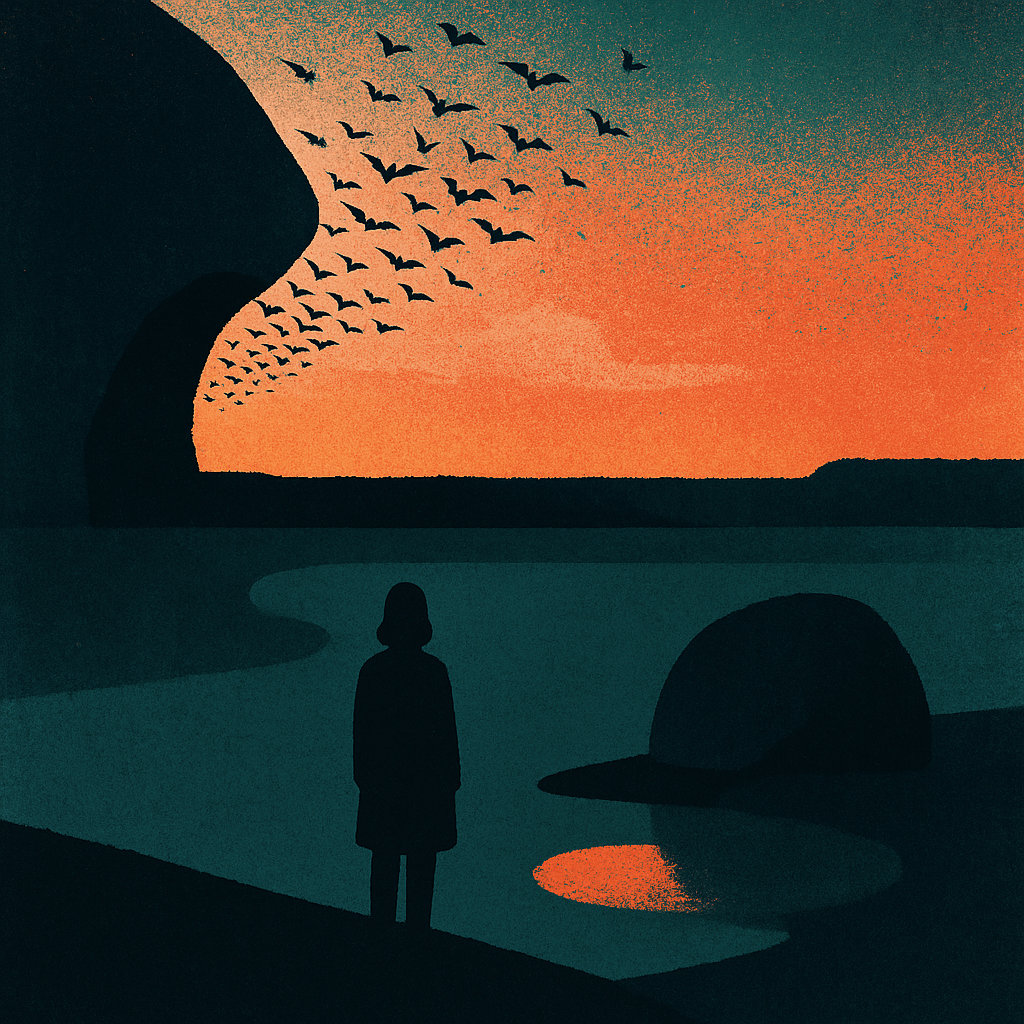
Every night, just before the heat folds back into the limestone and the drones blink out above the highway, the bats rise from the cave off 290. A ribbon of them, thin at first, like a secret testing the edges of a whisper. Then more. A rush. A violent cloud.
That summer, no one had seen Vera Quan.
She wasn’t exactly famous, but you wouldn’t call her obscure either. Artist, essayist, known for her field recordings and lecture-performances, the kind of person who didn’t so much speak as vibrate meaning into a room. Her last talk was held underground, in a reclaimed recharge zone below the Edwards Aquifer, where the city once tried to reroute water like it rerouted people — quietly, bureaucratically, and without apology.
I didn’t know her well. We’d only met twice. Once at a city-funded art show in the Seaholm Intake Building, where she spoke about “form as control,” and once again at a backyard party where someone was grilling jackfruit. Both times she had that look — like she was already listening to something you couldn’t hear yet.
The disappearance was not sudden, but it was complete. No calls. No posts. No scheduled appearance at the Salado symposium. The first people to notice were the archivists, the second were the poets. Her absence unfolded not with urgency, but with a kind of sinking.
⸻
The story goes that Vera’s final lecture was about emptiness. That she performed it without a script, pacing slowly across a cracked concrete floor beneath the city, her voice echoing against limestone walls wet with old water. “This,” she began, “is a lecture written with my voice.” And then: “The cave is not known by its walls, but by what spills out of it.”
They say she described the bats in great detail — how they emerge from the hole like punctuation marks, how their volume gives shape to the space they leave behind. A kind of negative geometry. The measure of hollow things.
That detail stuck with me. The idea that you can only know a place by what exits it.
⸻
I began walking more after she vanished. Not out of intention, but because my body seemed to want something that didn’t involve a screen or another message marked “urgent.” I wandered Shoal Creek, poked around the edge of the closed-off section near 183, passed the signs about water quality and rattlesnakes.
And one day, I found her name again — not in a news alert or on a flyer, but etched into a limestone block behind the old Whole Earth store: V. Quan — 2029. It was faint, half-covered in moss, but I knew it wasn’t a mistake.
I started looking for other signs.
⸻
The city’s map of the aquifer is elegant and clean — a blue rectangle stretching beneath everything from the edge of the desert to downtown. But that’s a fiction. Anyone who’s dropped a sensor into the groundwater knows better. The rock is spongy, carved with impossible time. The water moves like memory — slow, partial, untraceable. Vera once called it “a negative ecology.” She said the aquifer was an archive that refused to be cataloged.
What if she’d gone into it? Not metaphorically, but physically?
⸻
I met an old contact, Julia, a hydrologist-turned-sculptor who now lives in a suspended greenhouse off Montopolis. She keeps air plants, solar stills, and broken ceramic chairs wired to recording devices. Julia said Vera had been experimenting with “acoustic sediment.” Using field recordings of dripping water to write text — not language exactly, but vibration, echo, interval.
“She told me the cave was her final collaborator,” Julia said. “That it was teaching her to un-write.”
I didn’t ask what that meant.
⸻
Three months later, a film appeared online. No metadata, no credits. Just a static shot of the bats rising at sunset. Thirty uninterrupted minutes. Then silence. Then, at minute thirty-one, Vera’s voice — distant and calm:
“I watched the bats leave and understood the cave not as emptiness, but as the record of everything it had held. What pours out is a way of knowing. And what remains is not absence, but volume.”
The screen went dark.
⸻
I don’t know if she’s alive. But I do know that I began hearing water differently after that. Every faucet, every puddle, every echo in the tunnel under Mopac felt like a whisper. Not of her, exactly — but of something she touched. The city had always tried to forget what flowed beneath it. Vera reminded it.
Sometimes, at night, I walk to the mouth of the cave. I watch the bats emerge, a thin line, then a chaos, then a dance.
🚮 W.A.S.T.E.: Words Assisting Sustainable Transformation & Ecology
| Term | Definition |
|---|---|
| (Underground) (0.00) | Amidst the tranquility of a botanical garden lies a hidden passage to an underground archive, its entrance marked by a cryptic stone carving. This secluded realm, a haven of esoteric literature, beckons the advanced student and researcher to delve into mysteries veiled in ancient manuscripts, awaiting the touch of the curious to unveil their arcane knowledge. |
| Bat Weather (0.00) | Practice of local repair, reuse, mutual care, and shared access. People use scrap, skills, and trust to keep each other safe and resourced when official systems fail. |
| Cane of Blossoms (0.00) | An elder’s staff that grows as both root and record, carrying wisdom in living wood. |
| Clandestine Collective (0.00) | A hidden network of urban stewards who move beneath the official grid, planting quiet interventions such as living walls, water hacks, and spectral gardens that reshape the city without ever claiming credit. |
| Cultural Shift (0.00) | This section tracks how values, habits, and public space change when a city commits to circular practice. In Austin, neighbors trade skills, repair before buying, and design for reuse. Rings of contribution replace price tags. Libraries, depots, and gardens become the new main street. The mycelial network carries stories, trust, and logistics. Culture moves from me to we without losing room for individual expression. What you will find here: • Signals: new words, rituals, and cues that mark progress. • Practices: repeatable actions you can start this week. • Places: sites where the change is already visible. • Stories: Organic Fiction that lets readers rehearse the future. • Metrics: simple counts that show whether care is growing. Use this to learn, copy what works, and leave your own trace. The shift is live. Help steer it. |
| Eva Marquette (0.00) | A brilliant strategist and field operative driven by conviction more than faith. Once a scientist within ReLeaf, Eva turned rebel after uncovering The Gardener’s manipulation of bioengineered ecosystems. Focused, sharp, and quietly defiant, she balances intellect with intuition, often serving as Langley’s moral compass and tactical equal in the fight to reclaim Future Austin’s freedom. |
| Future Austin (0.00) | Future Austin invites you to explore a luminous vision of the city’s tomorrow—where imagination and reality intertwine to create a thriving, sustainable urban landscape. Here, grassroots ingenuity and cutting-edge technology power communities, transforming Austin into a place of boundless possibility. Through insightful articles and evocative Organic Fiction, you’ll glimpse futures shaped by innovators like ReLeaf, whose bold strategies—such as Vertical Garden Fairs in schools—seed green revolutions in unexpected places. From unconventional movements like Trash Magic reimagining music distribution, to fictional worlds alive with unseen energy and harmony, this collection offers both practical inspiration and immersive storytelling. Whether you’re drawn to actionable sustainability or simply wish to lose yourself in tales of a resilient, radiant future, Future Austin points toward the city we could create—and the one we must. |
| Glyphseed (0.00) | A fungal mark or symbol that plants in soil or screen alike, sprouting decisions as if they were seedlings. |
| Immigration (0.00) | Immigration is a topic that often triggers passionate debates and stands at the intersection of economic, social, and cultural issues. However, within these complex debates, stories of innovation and integration often emerge, highlighting how communities and companies can play pivotal roles in shaping the immigration narrative. In this section, we turn our attention to Austin, Texas, and the remarkable efforts of a local enterprise, ReLeaf. Through their vertical gardens initiative, ReLeaf has addressed the challenges and embraced the opportunities of immigration in a unique and inspiring way. We delve into how ReLeaf is providing sustainable employment and community engagement opportunities for immigrants. We explore the company's role in assisting individuals in their journeys from homelessness to empowerment, and how it leverages this process to create positive change on a wider scale. Join us as we uncover the transformative power of community-driven action in addressing immigration. As we venture into this narrative, we invite you to consider the potential of similar initiatives to inspire positive change and foster integration in communities around the globe. |
| Photosynthetic Choir (0.00) | A collective of altered beings whose breath and leaves merge into a single voice of vegetal cognition. |
| Planterns (0.00) | Planterns are whimsical upcycled creations—paper lanterns transformed into one-of-a-kind planters. No two are ever the same: each Plantern carries its own identity, tied to a unique ID that connects it to specific digital media such as Organic Fiction narratives, recorded music, and other creative works. The soft glow and airy shape of its former life remain, now reimagined as a home for trailing vines, succulents, and blooms. Made from reclaimed materials, Planterns celebrate renewal—giving discarded objects a second chance and your plants a distinctive stage to grow. Part art piece, part living sculpture, a Plantern is both physical and digital—a tangible vessel for life linked to a story, a song, or a world you can step into. |
| Planthroposcript (0.00) | The living blueprint written by vines that overwrites floor plans with botanical intent. |
| Rootpulse (0.00) | A faint vibration sensed through soil or concrete when bio-infrastructure awakens. |
| Sara Stevenson (0.00) | I'm a middle school librarian, and I first saw a free little library up in Seattle this summer. l've seen them popping up around town and told my husband I would love him to make me one. Never did I imagine he would produce such a fine piece of woodwork and construction, a mini replica of our house. Now I can be a 24-hour librarian. |
| Shoal Creek (0.00) | Shoal Creek is changing. At the Seaholm Intake, the water and stone hold a new role for the city. Engineers and naturalists are close to confirming a time-bending effect in the current. Short pulses move both downstream and upstream. Standing near the intake leaves people rested and clear, as if a long afternoon just ended. This site becomes a public time commons. The cooled chambers host sensors and quiet rooms. The walkway links to Central across the water. The mycelium network listens, then routes what the creek gives: steadier attention, better recall, and a calm pace for work and care. What to expect: Check-in stones that log a short visit and return a focus interval Benches that sync with the flow and guide five-minute rest cycles A simple light on the rail that signals when the current flips A small desk for field notes and shared observations Open data on pulse times so neighbors can plan repairs, study, and gatherings Invitation Come without hurry. Sit by the intake. Let the water set your pace. Then carry that steadiness back into the city. |
| Sunspine (0.00) | The radiant ridges of the Strawbactus paddies, holding the memory of desert heat. |
| Trust Current (0.00) | A mild tingling behind the eyes when people witness a verified act of generosity. Neurologists call it a mirror-empathy response; poets call it the return of faith. |
Ledger balance
Link to this Organic Media: