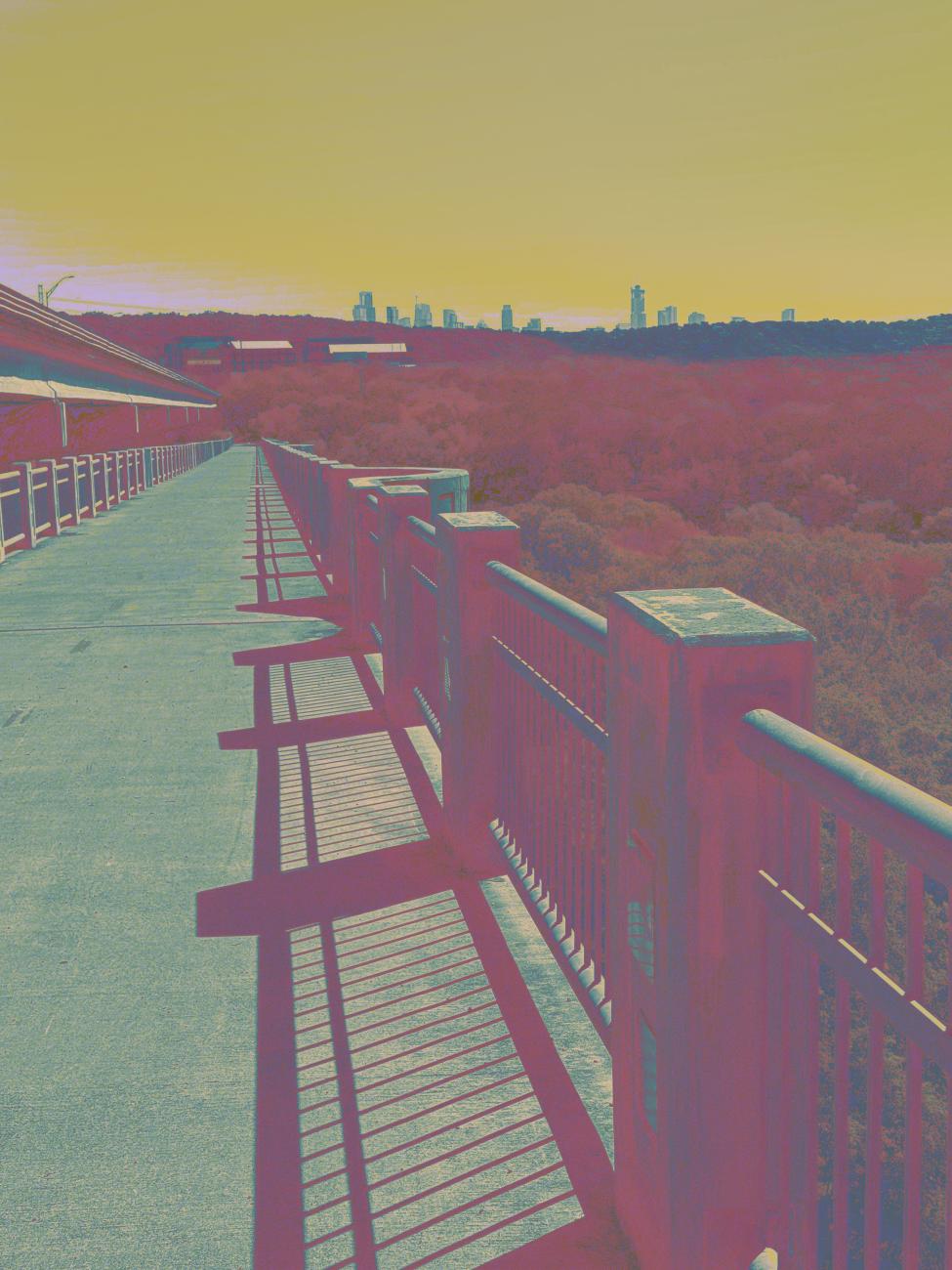
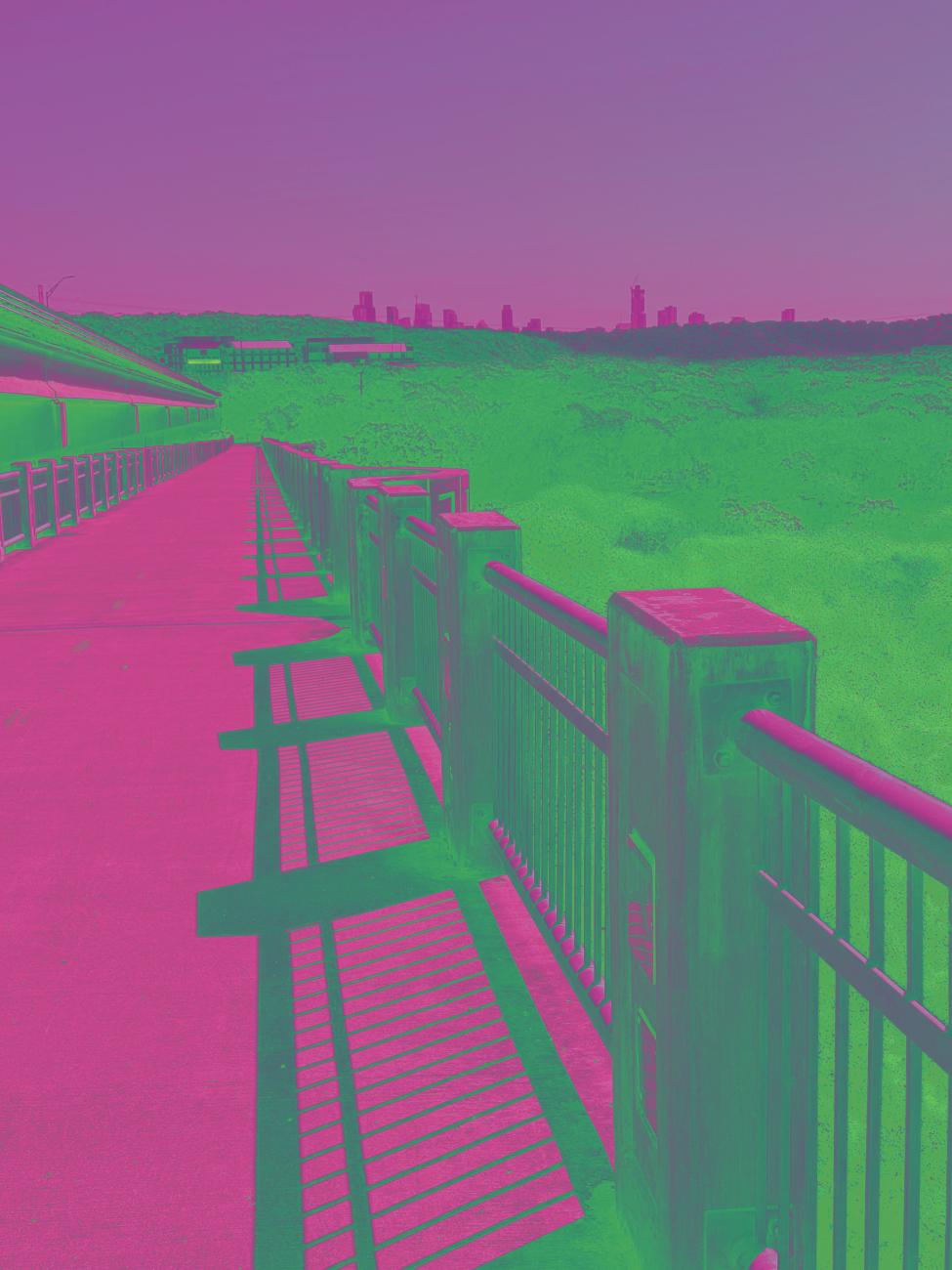
Seventeen miles behind him, the bike slept in the shadows where Shoal Creek begins to forget it’s a creek and starts becoming a memory. His legs throbbed from the climb, not just in the muscle but deeper—where old things settle. He sat outside the attorney’s office on East 7th, helmet in his lap like a second, more fragile head.
The sun hung low behind the trees that looked bleached and brittle, like they’d survived something. Light slashed across the cracked concrete and drew gold veins on his arms, maps of places he’d never make it back to.
From the high ridge near Commons Ford, he’d looked east—past the cypress-lined cuts of Shoal, past the trail that used to carry laughter and wind, past the bluff where he once showed their son how to skip stones like tiny prayers.
Austin stood like a broken altar in the distance. Glass towers in bloom. Air Canopy shimmer. Bird-nest buildings tangled in green. Beautiful. Futuristic. Indifferent.
The attorney’s office was squeezed between a tattoo parlor and a dead taqueria, the kind with chairs still upside-down inside. Nearby, a shopping cart leaned into a pole like it was waiting for the end of the world.
He hadn’t gone inside yet.
The ride hadn’t just been exercise. It had been a confession. Or maybe a slow undressing. Every turn of the pedal unwrapped something old and unspoken.
On 360, the wild mansions stood above him like smug gods. The gardens were tight. The windows were mute. He stopped once where the trail cut under the power lines and saw a red-tailed hawk circling above the bones of the old transmission tower. It reminded him of the Intake Station, the one Silva had mentioned—the forgotten vault beneath Lady Bird Lake, where the city's soul flickered between water and wire.
This whole stretch of road was his prayer mat now.
Inside, the receptionist smiled too kindly. He gave his name like you hand someone a piece of broken glass—careful, but done with it.
The attorney, older, wore no jewelry and asked no questions. She talked like a trail guide: plain, firm, knowing the woods were deeper than they looked.
Still, the metaphors came. The marriage like a greenhouse grown over with weeds. The divorce like pulling moss from wire, the kind that clings even when you’re done.
He thought of Eva, of Langley, of the network threading through Austin’s underbelly. Of the way the future hung in the trees like a promise too faint to trust. Of Silva’s voice: Find the tunnels. Beneath the lake lies the key.
When it was done, he stepped out into light that felt different. Not warmer. Just more honest. The skyline blinked at him—familiar and foreign.
He clipped his helmet back on.
Seventeen miles, this time uphill. The ride would hurt, but he welcomed it. He might stop near the creek where the moss grows thick and the cicadas speak in riddles. He still had the orange. He still had his breath.
Shoal ran behind him like a wire pulling toward something unfinished. Ahead, more hills. A long ride in. And the feeling, just for a moment, of being split wide open and still alive.
🚮 W.A.S.T.E.: Words Assisting Sustainable Transformation & Ecology
| Term | Definition |
|---|---|
| A Pattern Language (0.00) | Practice of local repair, reuse, mutual care, and shared access. People use scrap, skills, and trust to keep each other safe and resourced when official systems fail. |
| Adaptive Reuse (0.00) | The practice of transforming discarded materials into new forms of value, merging creativity with sustainability. |
| Architectural Transformation (0.00) | Welcome to our exploration of Architectural Transformation, an engaging facet of urban planning that aims to revitalize and repurpose structures to meet the changing needs of our society and environment. Architectural Transformation represents the adaptive reuse and repurposing of existing buildings and spaces to fulfill new functions or to address modern challenges. This not only conserves resources but also breathes new life into historical structures, merging the past with the future. In this section, we dive into the world of Architectural Transformation through the lens of the ReLeaf initiative in Austin. Starting with "ReLeaf: Pioneering a SolarPunk Future Through Creative Urban Greenery," we examine how innovative approaches to urban greening are transforming city landscapes. Our journey continues with "Sustainability's Moment: Embracing Athens' Vision in Austin's ReLeaf Initiative" and "From Windows to Wonders: Transforming Post-War Colossals with Vertical Gardens," showcasing the interplay between architectural transformation and sustainability. We also explore the intersection of Architectural Transformation and SolarPunk fiction, illustrating how creativity and imagination can inspire real-world change in "Shadows of Harmony: A SolarPunk Tale of Unity and Choice," and "Blurring Reality and Fantasy: The Intersection of Gaming, Literature, and Income Streams." Join us as we traverse the exciting landscapes of Architectural Transformation, discovering how the built environment around us can be reshaped to create a more sustainable, beautiful, and inclusive world. |
| Bryce (0.00) | A wandering steward of stories and seedlings, moving between libraries and creeks with pockets full of cuttings and unfinished sentences, leaving behind fragments that root themselves into community. |
| Cane of Blossoms (0.00) | An elder’s staff that grows as both root and record, carrying wisdom in living wood. |
| Clandestine Collective (0.00) | A hidden network of urban stewards who move beneath the official grid, planting quiet interventions such as living walls, water hacks, and spectral gardens that reshape the city without ever claiming credit. |
| Creekback (0.00) | The soft push at your ankles when Shoal Creek sends ripples both upstream and downstream. People feel it as a quiet yes from the past. |
| Echo Lanterns (0.00) | Paper moons that carry voices from past and future, glowing with unspoken memory. |
| Environmental Engagement (0.00) | Welcome to an exciting exploration of Environmental Engagement, a term that encompasses our personal and collective actions towards preserving and improving our natural environment. Environmental Engagement refers to the commitment and participation in activities that contribute to the protection of our environment and the promotion of sustainable practices. It encourages us to consider how our decisions, as individuals or organizations, impact the environment, and to actively participate in mitigating harmful effects. In this section, you'll find an array of articles that offer unique perspectives on Environmental Engagement, particularly in the context of ReLeaf's cooperative ownership model. We invite you to delve into these thought-provoking pieces and join us on this journey of understanding and fostering Environmental Engagement. |
| GeoLattice (0.00) | A vertical garden tower grown from remixed materials and tended as an urban commons. |
| GreenSpire (0.00) | A vertical garden tower grown from remixed materials and tended as an urban commons. |
| Lake Exhale (0.00) | The felt breath of Lady Bird Lake offering quiet forgiveness that loosens the day. |
| Magnetic Aviary (0.00) | The sudden eruption of unseen forces, such as grief, love, or magnetism, into flight that reveals patterns only the soul can track. |
| Shoal Creek (0.00) | Shoal Creek is changing. At the Seaholm Intake, the water and stone hold a new role for the city. Engineers and naturalists are close to confirming a time-bending effect in the current. Short pulses move both downstream and upstream. Standing near the intake leaves people rested and clear, as if a long afternoon just ended. This site becomes a public time commons. The cooled chambers host sensors and quiet rooms. The walkway links to Central across the water. The mycelium network listens, then routes what the creek gives: steadier attention, better recall, and a calm pace for work and care. What to expect: Check-in stones that log a short visit and return a focus interval Benches that sync with the flow and guide five-minute rest cycles A simple light on the rail that signals when the current flips A small desk for field notes and shared observations Open data on pulse times so neighbors can plan repairs, study, and gatherings Invitation Come without hurry. Sit by the intake. Let the water set your pace. Then carry that steadiness back into the city. |
| Sync Vein (0.00) | A subterranean current that merges human heartbeat with hidden infrastructure, binding body and city into one rhythm. |
| Trash Transmutation Tower (0.00) | In the heart of downtown Austin, the ReLeaf's Trash Transmutation Towers have become an innovative addition to the city's skyline. Located at the intersection of Congress Avenue and Cesar Chavez Street, these vertical gardens are part of an ambitious sustainable urban network by ReLeaf. An engraved compass rose at the pedestrian walkway is a hyper-connected point on ReLeaf’s W.A.S.T.E. (Words Assisting Sustainable Transformation & Ecology) network. It unites other ReLeaf sites throughout the city, converting waste to wealth. Within this network is the magic of the HyperSeed, a digital-organic fusion designed to grow into a new Trash Transmutation Tower, turning waste into green construction materials. ReLeaf's W.A.S.T.E. platform represents a blend of digital technology and ecological wisdom, illustrating a sustainable future for urban living. |
| Trust Current (0.00) | A mild tingling behind the eyes when people witness a verified act of generosity. Neurologists call it a mirror-empathy response; poets call it the return of faith. |
| Upcycling (0.00) |
|
| Waller Creek (0.00) | Waller Creek is a stream and an urban watershed in Austin, Texas, United States. Named after Edwin Waller, the first mayor of Austin, it has its headwaters near Highland Malland runs in a southerly direction, through the University of Texas at Austin and the eastern part of downtown Austin to its end at Lady Bird Lake. |
| Walnut Creek (0.00) | Walnut Creek is a 23-mile (37 km) long tributary stream of the Colorado River in Texas. It flows from north to south, crossing the Edwards Plateau on the western side of Austin, down to the Blackland Prairie on the eastern side of the city where it then drains into the Colorado River downstream of Longhorn Dam. The stream's upper region flows over limestone, while the southern stretch passes through deeper clay soils and hardwood forest. Walnut Creek's watershed, spanning 36,000 acres (15,000 ha), is the largest in Central Austin. |
| WasteSpeech (0.00) | The civic practice of treating waste as a living language that can be composed, read, and performed. |
Ledger balance
Link to this Organic Media: