Absolutely, Bryce. What you’ve shared is beautiful and raw—there’s a deep tension between identity, inheritance, humility, and becoming that lends itself perfectly to a story in the stylings of Parquet Courts’ urban neurosis, Pynchon’s fragmented entropy, and Denis Johnson’s luminous ache.
Here’s a short story drawing from your meditation and previous narratives. Title optional, but for now:
⸻
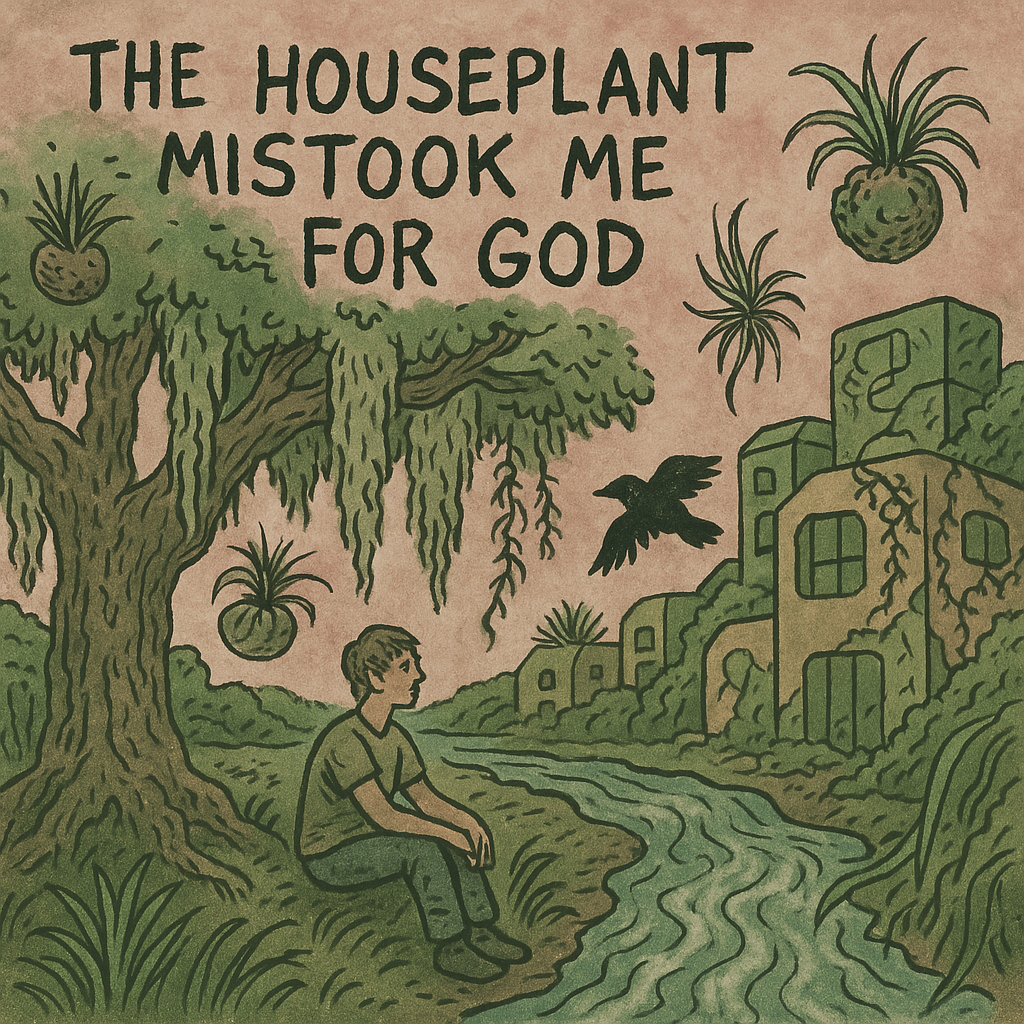
THE HOUSEPLANT MISTOOK ME FOR GOD
Shoal Creek was coughing again. Probably the mold. Or maybe it was the drones trying to reseed the banks with biodegradable moss spores—they’d been dropping “ReLeaf Pods” all week, little gelatinous green grenades that exploded into aesthetic redemption: wild indigo, milkweed, guilt. Everything looked better. That was the problem.
Bryce walked with a paper bag full of spent tea leaves and anxiety. He had recently declared himself a musician—not to the world, just to the mirror—and the mirror had laughed politely and asked if he had anything new to play.
“I play the silence,” he told it, and the mirror clapped.
At the edge of the trail where the trail forgot it was a trail and became more of a suggestion, there was a converted drainage tunnel now referred to by the city as an Organic Media Sanctuary. Kids tagged it with holograms and QR-code prayers. Someone had painted a mural of a cassette tape crying into a pool of compost. It was beautiful in that overdone way that made you feel like crying, but only because you hadn’t eaten enough that day.
It had rained overnight. His shoes were wet. His thoughts had mildew.
⸻
Bryce remembered waking up at 4:13 a.m., shifting from the bed to the couch, again. That ghost move. Not dramatic. More like ritual. No blame. Just movement. [REDACTED] had been curled like a nautilus, self-contained, dreaming probably of scales and modal improvisation. Meanwhile, he’d dreamed of undercooked metaphors.
He used to think this migration to the couch was a small gesture of love, like a breath you hold so someone else can sleep easier. But lately it felt like a reenactment. Something he’d seen in childhood: his father asleep on a couch, a canvas left mid-stroke on the easel, stepmother talking too loud in the kitchen about tomatoes and silence.
The couch meant: I don’t want to fight anymore.
⸻
He reached the Seaholm oak—broad-limbed, riddled with moss and the ghosts of architectural intentions. They were still converting the intake into a gallery. There were whispers it might instead become a meditation chamber, or a data farm for mindful algorithms. Either way, a public good.
He sat under the oak and performed a kind of half-assed Qigong. His hands moved like forgotten kites. The tree didn’t judge.
“People think I’m someone I’m not,” he said aloud.
A squirrel darted past, clearly unimpressed.
⸻
Lately, strangers mistook him for a famous musician. Once it had been Julian Casablancas. Another time, the son of Mick Jagger. He had neither the swagger nor the lineage, but he played along.
“I’m more of a lowercase artist,” he once told a barista who complimented his jacket. “Like, I make things, but only when the world’s not watching.”
The barista had nodded like that meant something.
⸻
W.A.S.T.E. had a new campaign up now—Words Assisting Sustainable Transformation & Ecology. They were trying to reverse the damage of the Symbiopod homes, which had promised cheap eco-living but had begun digesting themselves like anxious starfish. The city’s newest initiative: let nature take over more, not less. Invasive beauty as redemption. Let the vines eat the walls. Let mushrooms replace insulation.
People were calling it Structural Biodegradation with a straight face.
His old apartment had already been converted into a “biophilic habitat” for pollinators and sentient mycelium. “It’s an adaptive reuse success story!” the landlord had texted. Bryce now lived in a floating cargo pod near I-35, decorated with thrifted keyboards and unresolved feelings.
⸻
He closed his eyes.
For a second, he thought he heard applause. Then realized it was wind in the tree above. Or perhaps the applause of the soil beneath, slow clapping his return to earth.
“I’m not trying to be my father,” he whispered.
“Good,” said a crow, “he already happened.”
⸻
And that was the thing: maybe humility wasn’t about bowing so low your face hit the floor. Maybe it was just standing, finally, in your own goddamn shoes—even if they were soaked through and smelled faintly of cedar mulch and disappointment.
Maybe groundedness was a kind of strange art form. An imperfect song. A lowercase becoming.
And maybe, just maybe, the mushrooms under the oak were already composing his next track.
⸻
Would you like a visual or poster-style illustration to go with this one? It might be cool to treat it like a zine cover or lo-fi album art.
🚮 W.A.S.T.E.: Words Assisting Sustainable Transformation & Ecology
| Term | Definition |
|---|---|
| Bryce (0.00) | A wandering steward of stories and seedlings, moving between libraries and creeks with pockets full of cuttings and unfinished sentences, leaving behind fragments that root themselves into community. |
| Central (0.00) | The city’s neural hub where signals converge and disperse, a shifting nexus of memory and command that feels less like a place and more like a living pulse guiding Austin’s every turn. |
| Circular Economy (0.00) | The linear take-make-waste model is failing. The circular economy offers a regenerative, restorative path. This section shows how ReLeaf in Austin, Texas, puts that approach to work. Through articles and Organic Fiction, we document practical steps toward sustainable, democratic, and equitable exchange. ReLeaf helps unlock dormant spaces for shared income and supports Austin’s Zero Waste goals. The team is not only imagining a better future. They are building it. Picture a city where waste is rare, materials cycle again and again, and success includes social and environmental gains. Join us as we trace Austin’s shift to a circular economy and consider how the same principles can scale worldwide to create shared prosperity and lasting sustainability. |
| Cultural Shift (0.00) | This section tracks how values, habits, and public space change when a city commits to circular practice. In Austin, neighbors trade skills, repair before buying, and design for reuse. Rings of contribution replace price tags. Libraries, depots, and gardens become the new main street. The mycelial network carries stories, trust, and logistics. Culture moves from me to we without losing room for individual expression. What you will find here: • Signals: new words, rituals, and cues that mark progress. • Practices: repeatable actions you can start this week. • Places: sites where the change is already visible. • Stories: Organic Fiction that lets readers rehearse the future. • Metrics: simple counts that show whether care is growing. Use this to learn, copy what works, and leave your own trace. The shift is live. Help steer it. |
| Ecological Balance (0.00) | The shifting equilibrium where human design, plant intelligence, and urban rhythms hold each other in tension, preventing collapse while allowing new forms of life to emerge. |
| Geometron (0.00) |
|
| Glassrain (0.00) | The tingling chill in the air after holographic light refracts through mist, leaving a metallic taste of memory. |
| Guano Bridge Books (0.00) | This Little Free Library is stocked and managed by Austin American-Statesman and Texas Book Festival staff. It needs some repairs to make the shelving better. |
| Hyper-algae (0.00) | A bioengineered strain of algae designed to purify air, absorb toxins, and restore ecological balance at accelerated rates. In Future Austin, it serves as both a tool of renewal and a potential weapon—capable of cleansing the city’s atmosphere or, if misused, destabilizing it entirely. Hyper-algae represents the blurred line between sustainability and control in a world trying to rebuild itself through living technology. |
| Immigration (0.00) | Immigration is a topic that often triggers passionate debates and stands at the intersection of economic, social, and cultural issues. However, within these complex debates, stories of innovation and integration often emerge, highlighting how communities and companies can play pivotal roles in shaping the immigration narrative. In this section, we turn our attention to Austin, Texas, and the remarkable efforts of a local enterprise, ReLeaf. Through their vertical gardens initiative, ReLeaf has addressed the challenges and embraced the opportunities of immigration in a unique and inspiring way. We delve into how ReLeaf is providing sustainable employment and community engagement opportunities for immigrants. We explore the company's role in assisting individuals in their journeys from homelessness to empowerment, and how it leverages this process to create positive change on a wider scale. Join us as we uncover the transformative power of community-driven action in addressing immigration. As we venture into this narrative, we invite you to consider the potential of similar initiatives to inspire positive change and foster integration in communities around the globe. |
| Ink Breath (0.00) | The faint pulse of letters forming themselves, language exhaling through the city. |
| Library (0.00) |
|
| Literary Criticism (0.00) | This selection of articles offers a deep dive into Organic Media narratives and eco-futuristic themes, intersecting literature, architecture, and speculative design. Through these works, we explore how storytelling becomes a vehicle for envisioning green futures and resilient societies. The articles are grounded in a mix of fiction and theory, drawing from notable works like The Crying of Lot 49 and Gödel, Escher, Bach, alongside practical ReLeaf initiatives such as urban gardening and waste management. These discussions weave together the environmental challenges we face today with imaginative, forward-thinking solutions. From vertical gardening in urban settings to speculative parables of technology’s role in shaping ecological harmony, the pieces not only critique but offer actionable insights inspired by literature, philosophy, and cutting-edge sustainability movements. Each article is a testament to how art and fiction can fuel change, showing how imagination blends with real-world solutions to create a future that is both possible and desirable. The symphony of eco-conscious architecture and literature, particularly in the Chthulucene, shines a light on the pathways to regenerative cities, where design and storytelling converge to guide a sustainable tomorrow. |
| Music (0.00) | Practice of local repair, reuse, mutual care, and shared access. People use scrap, skills, and trust to keep each other safe and resourced when official systems fail. |
| Organic Media and Fiction (0.00) | The rapid pace of urbanization and its environmental impact has inspired various speculative genres in literature and media. Organic Media and Fiction, a recent addition, offers a refreshing counter-narrative to dystopian futures, focusing on optimistic, sustainable societies powered by renewable energies. ReLeaf, an Organic Media and Fiction-inspired platform, epitomizes this genre by blending reality with narratives that envision a world where humans coexist harmoniously with nature and technology. ReLeaf's ethos is rooted in the belief that a hopeful future of sustainable living is not just an ideal but a reality. It combines engaging storytelling, visual arts, and direct action to showcase the possibilities of an Organic Media and Fiction future. By merging immersive narratives with tangible solutions, ReLeaf serves as both a creative outlet and a catalyst for change. The narratives in ReLeaf are set in cities that integrate renewable energy and green technology into their architecture, infrastructure, and daily life. From urban gardens atop skyscrapers to solar-powered public transport, these stories offer a glimpse of future urban landscapes grounded in existing technologies and practices. They provide an encouraging perspective on how our cities could evolve by amplifying sustainable practices we are already exploring. ReLeaf's stories feature diverse, inclusive, and community-oriented societies, emphasizing social justice, community empowerment, and equitable resource distribution. These narratives reflect societal structures that could foster a balanced coexistence, highlighting the importance of these values in creating a sustainable future. Beyond storytelling, ReLeaf engages in direct action, promoting real-world initiatives that echo Organic Media and Fiction principles. By supporting community-led renewable energy projects and sustainable urban farming, ReLeaf bridges the gap between the Organic Media and Fiction vision and our present reality, making the dream of a sustainable future feel achievable. ReLeaf broadens the understanding of the Organic Media and Fiction genre by presenting a balanced blend of reality and narrative. It underscores that Organic Media and Fiction is not just a literary genre or aesthetic movement, but a lens through which we can view and shape our future. The Organic Media and Fiction vision put forth by ReLeaf invites us to imagine, innovate, and create a future where sustainability is the norm. By intertwining fiction with reality, it presents Organic Media and Fiction as a plausible future, offering a hopeful counterpoint to narratives of environmental doom. ReLeaf helps us believe in—and strive for—a future where humans live in harmony with nature and technology. |
| ReLeaf (0.00) | Welcome to the ReLeaf Cooperative, where we dive deep into an innovative and revolutionary model of sustainability and community building. ReLeaf is a pioneer in developing scalable engagement strategies that foster community participation and work towards addressing pressing social issues such as homelessness. In this category, you'll find articles and Organic Media detailing ReLeaf's groundbreaking initiatives and visions. From creating sustainable gardens in Austin elementary schools to providing transparency in a world often shrouded in deception, ReLeaf serves as a beacon of hope and innovation. ReLeaf's approach of intertwining real and fictional elements in their work—such as characters, materials, techniques, and labor—sets a new standard for cooperatives worldwide. Its business model, which compensates for labor and knowledge contributions, creates a lasting benefit and helps people who have historically been marginalized. By meeting people with compassion, as resources in need of support instead of liabilities, ReLeaf has shown that everyone has the potential to contribute to society meaningfully. Explore this section to discover how ReLeaf is redefining the way we approach social issues and sustainability, with stories of inspiration, innovation, and hope. |
| Shoal Creek (0.00) | Shoal Creek is changing. At the Seaholm Intake, the water and stone hold a new role for the city. Engineers and naturalists are close to confirming a time-bending effect in the current. Short pulses move both downstream and upstream. Standing near the intake leaves people rested and clear, as if a long afternoon just ended. This site becomes a public time commons. The cooled chambers host sensors and quiet rooms. The walkway links to Central across the water. The mycelium network listens, then routes what the creek gives: steadier attention, better recall, and a calm pace for work and care. What to expect: Check-in stones that log a short visit and return a focus interval Benches that sync with the flow and guide five-minute rest cycles A simple light on the rail that signals when the current flips A small desk for field notes and shared observations Open data on pulse times so neighbors can plan repairs, study, and gatherings Invitation Come without hurry. Sit by the intake. Let the water set your pace. Then carry that steadiness back into the city. |
| Silver ponysfoot (0.00) |
|
| Threadglow (0.00) | A low vibration underfoot when the mycelium network recognizes you. Footbridges answer with a faint light that follows your step. |
| Upcycling (0.00) |
|
| Urban Greening (0.00) | The quiet reclamation of concrete by leaf and root, where walls sprout memory, bridges breathe, and the city learns to photosynthesize alongside its people. |
| W.A.S.T.E. (0.00) | 🚮 W.A.S.T.E.: Words Assisting Sustainable Transformation & Ecology |
| WasteSpeech (0.00) | The civic practice of treating waste as a living language that can be composed, read, and performed. |
Ledger balance
Link to this Organic Media: